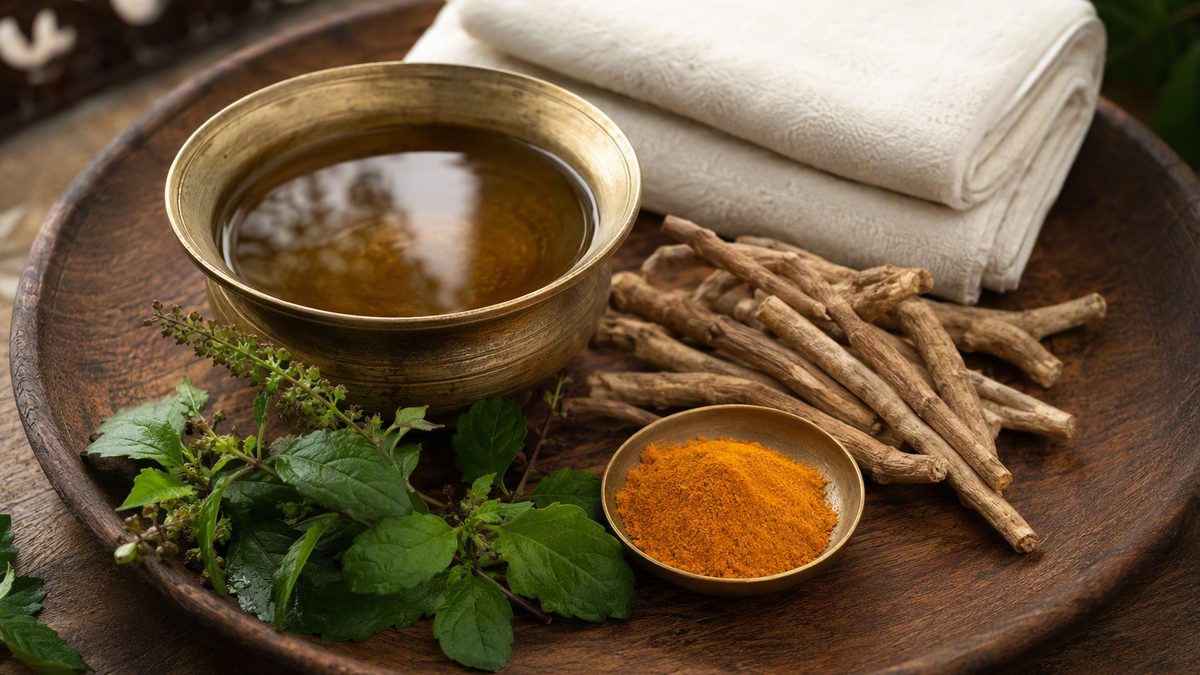
💡 Key Takeaways
- Ayurvedic recovery habits such as regular sleep, warm oil self-massage and eating at consistent times overlap with sound recovery practice, but the tradition itself has little direct trial evidence for sports recovery.
- The best-studied Ayurvedic herb in sport is ashwagandha; one small Indian trial found strength gains over placebo, which is promising but not settled.
- Quality is a real concern: a JAMA study found detectable lead, mercury or arsenic in about one in five Ayurvedic products sampled, so buy from tested, reputable makers.
- Do not rely on dosha types to choose training or food; there is no good evidence that this improves performance. Talk to a doctor before taking herbs if you have a medical condition or take medicines.
1. What does Ayurveda say about recovery, and what does science support?
Ayurveda is a traditional Indian system of medicine that frames health as a balance between three constitutional types, or doshas, and uses daily routines, food, herbs and massage to keep that balance. It does not have a direct equivalent of "recovery from training", so what people call Ayurvedic recovery is really a set of lifestyle habits borrowed from it.
Some of those habits are sound for reasons modern sports science also recognises: going to bed and waking at consistent times, eating regular warm meals, easing off after a hard day and slowing the breath before sleep. Others, such as choosing training according to your dosha, have not been tested in any rigorous way. This article separates the two groups so you can borrow what is useful without taking on claims that the evidence does not back.
Nothing here is medical advice, and no Ayurvedic practice has been shown to treat or cure a condition. Think of these rituals as optional additions on top of the things that matter most: enough protein, enough sleep and a sensible training plan.
2. Dinacharya: the daily routine, and why it overlaps with good sleep habits
Dinacharya is the Ayurvedic daily routine. It typically asks for waking early, a regular meal pattern with the main meal at midday, a lighter dinner, and winding down well before sleep. Stripped of the vocabulary, this describes a stable body clock, which is one of the better-supported recovery levers. Irregular sleep and late heavy meals make it harder to sleep well, and poor sleep reduces training quality.
If you want to try a dinacharya-style day, a realistic version looks like this:
- Wake and sleep within the same one hour window, including weekends.
- Eat your largest meal when you are most active, and keep dinner lighter and at least two to three hours before bed.
- Take a short walk after meals.
- Switch off bright screens in the last hour before bed and keep the room cool and dark.
None of this requires any herb or oil. Our guide on sleep hygiene for athletes covers the same ground in sports terms and is worth reading alongside.
3. Abhyanga: does warm oil self-massage help muscles recover?
Abhyanga is a self-massage with warm sesame, coconut or herbal oil, usually done before a bath. It is pleasant, it gets you to look at and touch your own muscles, and it relaxes many people. Whether the oil itself adds anything to the massage has not been tested in sports recovery trials.
What we do have is evidence on massage in general. The 2018 meta-analysis by Dupuy and colleagues, covering 99 studies, found massage was the most effective of the recovery techniques it compared for reducing delayed onset muscle soreness and perceived fatigue. Most of those studies used manual massage by a therapist rather than self-massage with oil, so the result may not carry over fully, but it supports the idea that touch and pressure on tired muscles is worth doing.
If you try abhyanga, five to ten minutes using firm strokes towards the heart is plenty. Patch-test any new oil on a small area of skin first, avoid broken or inflamed skin, and wash off oil properly before training so you do not slip. Be careful with oil on a wet bathroom floor, which is a common cause of falls.
4. Ashwagandha and other herbs: what evidence exists?
Ashwagandha (Withania somnifera) is the Ayurvedic herb with the most sports-related research. In an 8 week randomised, double-blind trial from India, Wankhede and colleagues gave 57 men aged 18 to 50 with little resistance training experience either 300 mg of ashwagandha root extract twice daily or a starch placebo while they trained. The ashwagandha group gained more strength on bench press and leg extension, and more arm muscle size, than the placebo group. The authors also reported a smaller rise in creatine kinase, a blood marker of muscle damage, though the reported figures are hard to interpret.
That is a real result, but it needs context. The trial was small, short, funded by the maker of the extract, and in beginners, who respond to almost anything that helps them train. It has not been confirmed at scale in trained athletes. We also do not know whether the effect depends on that specific extract. Our ashwagandha fitness guide goes deeper into the dosing studied and who should avoid it.
On safety, ashwagandha is not risk-free. Case reports of liver injury have been published, and it can interact with thyroid, sedative and immune-suppressing medicines. Avoid it in pregnancy, and speak to a doctor first if you have liver, thyroid or autoimmune problems or take regular medication. Stop and get medical advice if you develop yellow eyes, dark urine or persistent abdominal pain.
5. The quality problem with herbal products
Many Ayurvedic preparations are sold as supplements, and quality varies widely. In a 2008 JAMA study, Saper and colleagues bought 193 Ayurvedic medicines sold online and tested them. Detectable lead, mercury or arsenic was found in 20.7 percent. Products made in India and in the United States were equally likely to contain metals. The rates were higher in rasa shastra products, which deliberately include metals or minerals in their preparation.
The study is now some years old and regulation may have improved, but it is a good reason for care. A few ways to reduce the risk:
- Choose single-ingredient products from makers that publish third-party lab results for heavy metals.
- Avoid anything described as rasa shastra, bhasma or containing "purified" metals unless a qualified clinician prescribed it.
- Be cautious with imported or unlabelled products and anything that promises dramatic results.
- Tell your doctor about any herb you take, particularly before surgery.
6. A practical Ayurvedic-style recovery evening
If you want a low-risk way to try these ideas, here is a simple evening that adds nothing hazardous and keeps the basics in place.
- Eat a proper dinner with protein. Dal with rice or roti, paneer, curd or eggs gives you protein and carbohydrate. Warm, simply spiced food is easy to digest for many people.
- Optional abhyanga before a warm shower. Five to ten minutes, firm strokes, patch-tested oil.
- Ten minutes of slow breathing. Any slow nasal breathing, such as pranayama done gently, is fine. The aim is to calm yourself before bed, and slow breathing can lower stress in the short term for many people, although the long-term sports benefit is not established.
- Bed at a consistent time in a cool, dark room.
If you want to compare traditions, our shorter overview of Ayurvedic principles for fitness recovery covers adaptogens and breathing in less detail, and the tai chi recovery guide looks at another gentle practice.
7. How to judge any traditional recovery practice
The same questions are useful for Ayurveda, cupping, cryotherapy or whatever comes next on social media.
- What type of evidence is it? A randomised, placebo-controlled trial in humans carries more weight than a mouse study, a case report or a testimonial.
- How big and how long? A 57 person, 8 week trial is a starting point. Several trials in different groups, ideally in people like you, is better.
- Who paid for it and who made the product? Industry-funded trials of a single branded extract tell you about that extract, not the herb in general.
- Does it cost anything in sleep, money or safety? A warm meal and an earlier bedtime cost nothing. An unregulated powder carries real risk.
Using that checklist, the lifestyle parts of Ayurvedic recovery are low risk and plausible. The herbal parts are worth considering only with caution and medical advice. And none of it replaces the basics of protein, carbohydrate and sleep.
Related reading
8. Frequently Asked Questions
Q1: Is Ayurvedic recovery scientifically proven?
A1: Not as a system. Some individual habits, such as regular sleep and eating times, are supported by sleep science, and massage generally helps soreness. Ayurvedic techniques as a package have not been tested in good sports recovery trials.
Q2: Does ashwagandha help with muscle recovery?
A2: One 8 week randomised trial in 57 men aged 18 to 50 found greater strength gains than placebo with 300 mg twice daily, along with a smaller reported rise in muscle-damage markers that is hard to interpret. It was small, in beginners and funded by the extract's maker, so treat it as promising rather than proven. Check with a doctor first if you have liver or thyroid problems or take medicines.
Q3: Are Ayurvedic supplements safe?
A3: It depends on the product. A 2008 JAMA analysis found detectable lead, mercury or arsenic in 20.7 percent of Ayurvedic medicines tested. Choose products with third-party testing, and avoid metal-containing preparations unless a clinician prescribes them.
Q4: Do I need to know my dosha to train or eat for recovery?
A4: No. There is no good evidence that matching exercise or food to a dosha improves recovery or performance. Training load, protein intake, sleep and stress management matter far more.
Scientific References & Clinical Sources
- Wankhede S, et al. Examining the effect of Withania somnifera supplementation on muscle strength and recovery: a randomized controlled trial. J Int Soc Sports Nutr, 2015. PMID: 26609282
- Saper RB, et al. Lead, mercury, and arsenic in US- and Indian-manufactured Ayurvedic medicines sold via the Internet. JAMA, 2008. PMID: 18728265
- Dupuy O, et al. An evidence-based approach for choosing post-exercise recovery techniques to reduce markers of muscle damage, soreness, fatigue, and inflammation: a systematic review with meta-analysis. Front Physiol, 2018. PMID: 29755363
UltraFit360 is a free AI fitness coach with weekly coaching reports, workout programs and photo meal logging. See all features.