💡 Key Takeaways
- Your circadian clock runs slightly off a 24-hour day and is reset mainly by light, so morning light and dim evenings are the strongest levers you have.
- The 90-minute sleep cycle is an average, not a rule; aim for a consistent sleep and wake time rather than counting cycles.
- Caffeine, bright screens and late meals can each nudge the clock later, which makes falling asleep at a sensible hour harder.
- Shift the clock gradually, about 30 to 60 minutes every day or two, and use morning light to move it earlier.
1. What is your circadian rhythm and how does it control sleep?
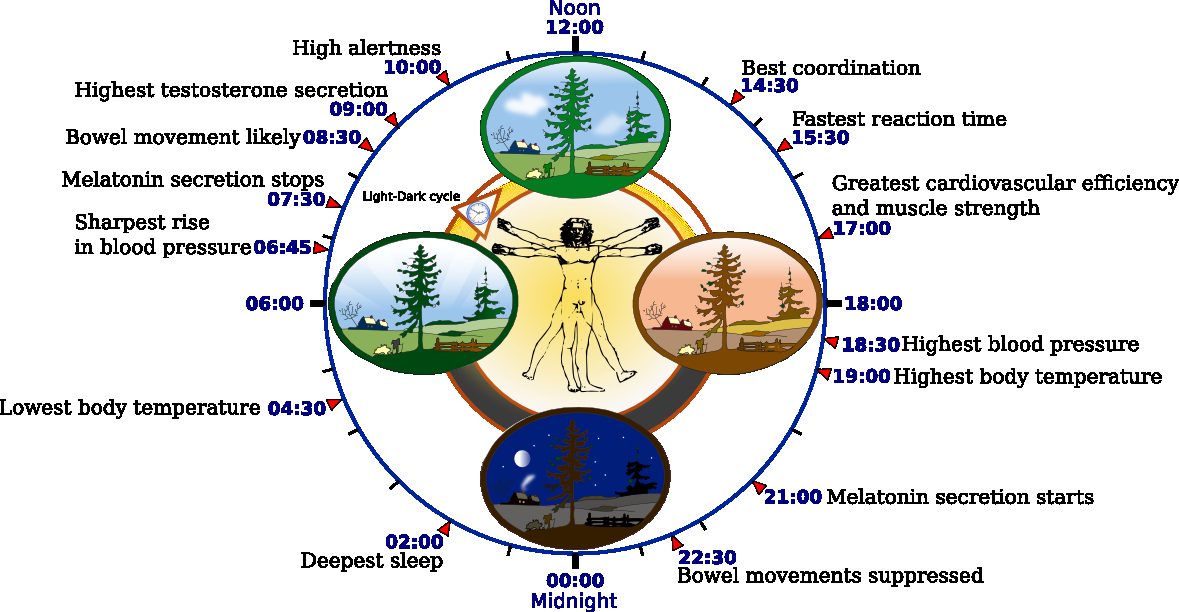
Your circadian rhythm is a roughly 24-hour internal clock, run by a small group of neurons in the brain's hypothalamus, that tells your body when to be alert and when to sleep. It does this by shifting body temperature, hormones such as melatonin and cortisol, and sleep pressure across the day, and it is kept in step with the outside world mainly by light reaching the eye.
Two processes decide when you actually fall asleep. The first is sleep pressure: the longer you have been awake, the stronger the drive to sleep becomes, and sleep clears it. The second is the circadian signal, which promotes wakefulness during the day and sleep at night regardless of how long you have been up. You sleep best when the two line up, which is why a long afternoon nap can leave you wide awake at midnight, and why an all-nighter feels worst in the early morning hours when the clock's alerting drive is at its lowest.
The clock is not exactly 24 hours long. In most people it runs a little over, which means that without daily cues it drifts later. Light, and to a lesser extent meals, activity and social timing, nudge it back every day. That daily correction is the reason light exposure sits at the centre of nearly every practical piece of circadian advice.
2. How do the sleep cycles work through the night?
A night of sleep is not one block. You move through lighter sleep, deeper slow-wave sleep and REM sleep in repeating cycles that last roughly 90 minutes, though the length varies between people and from night to night. Slow-wave sleep is concentrated in the first half of the night, while REM periods get longer toward morning.
This pattern is what makes the end of the night matter. If you cut sleep short by an hour or two by waking early, you lose a disproportionate share of REM, and if you go to bed very late after a long day you can still get plenty of deep sleep but less REM. You do not need to calculate bedtimes in multiples of 90 minutes; the cycles are too variable for that to work reliably, and waking from any stage is manageable if you have slept enough. Consistent timing and enough total hours matter far more than hitting a cycle boundary.
For athletes, the 2021 expert consensus (Walsh and colleagues) recommends that adults aim for seven to nine hours and notes that athletes often fall short. In one small trial of collegiate basketball players (Mah and colleagues, 2011), extending sleep was linked with faster sprints and better shooting accuracy. That trial was small and uncontrolled against a separate group, so treat it as encouraging rather than a promise.
3. Why does light matter so much, and when should you get it?
Specialised cells in the retina respond strongly to blue-weighted light and report to the clock. Bright light in the early part of your biological day moves the clock earlier, while bright light in the late evening and early night moves it later and suppresses melatonin. Dim light in the evening and bright light after waking is therefore the simplest schedule for most people.
The evidence for the evening half is reasonably solid. A laboratory study by Gooley and colleagues (2011) found that ordinary room light before bedtime suppressed melatonin onset and shortened the duration of melatonin release compared with dim light. A later experiment by Chang and colleagues (2015) found that reading on a light-emitting tablet before bed, compared with a printed book, delayed melatonin, delayed the clock and left people less alert the next morning. These were small, controlled studies in volunteers, not long-term trials, but the direction is consistent.
The other half comes from how far daylight can move the clock. In a small camping study (Wright and colleagues, 2013), a week of living with natural light only moved participants' melatonin timing earlier by roughly two hours compared with their normal electrically lit lives. Practically, that means:
- Get outdoor light within an hour of waking. Even an overcast sky is far brighter than most indoor lighting. A 15 to 30 minute walk or breakfast on the balcony does the job.
- Dim the lights in the last two hours before bed. Use lamps rather than overhead tubes, and keep screens lower and farther away.
- Keep the bedroom dark. A light-blocking curtain matters in cities where street lighting stays on all night.
4. What else shifts your body clock: exercise, caffeine and meals?
Light is dominant, but other cues have measurable effects. Exercise is one of them. In a lab study of 99 adults who did an hour of moderate treadmill exercise at one of eight times of day (Youngstedt and colleagues, 2019), exercise at 7 am and from 1 to 4 pm moved the clock earlier, while exercise from 7 to 10 pm moved it later. The effects were comparable to those of bright light of equal duration, but they came from short lab protocols, so do not expect training time alone to fix a delayed schedule, but it is a reason to avoid hard late sessions if you struggle to sleep. Our guide to chronotype and training time covers how to fit sessions around your natural tendencies.
Caffeine acts on the clock as well as on alertness. Burke and colleagues (2015) gave volunteers a double espresso equivalent of caffeine three hours before bedtime and found it delayed the melatonin rhythm by about 40 minutes in a small within-subject study. A separate trial (Drake and colleagues, 2013) found that a 400 mg dose (about four cups of coffee) taken even six hours before bed reduced total sleep time, measured objectively, though people did not always notice it. If you are a light sleeper, a sensible cutoff is around midday to early afternoon, particularly with strong filter coffee or pre-workout powders.
Meals also act as a timing cue, though the human evidence is thinner than for light. Eating a large meal late at night tends to coincide with later sleep and reduced sleep quality in observational data, but that does not prove cause. A reasonable approach is to finish your main meal two to three hours before bed and keep breakfast at a regular time, which anchors the day.
5. How do you shift your clock for jet lag, night shifts or a late schedule?
Move gradually and use light as the lever. The clock can usually move about one hour per day in the direction you want, and moving later is easier than moving earlier because the natural drift is later. To get earlier, shift bedtime and wake time 30 to 60 minutes earlier every day or two, get bright light soon after the new wake time, and avoid bright light late in the evening.
| Situation | Direction | Practical approach |
|---|---|---|
| Travelling east (for example India to Singapore or Japan) | Earlier | Seek morning light at the destination; avoid bright light late in the evening |
| Travelling west (India to Europe) | Later | Seek late-afternoon and evening light; sleep in a little if you can |
| Permanent night shift | Hold a later schedule | Bright light at the start of the shift, dark glasses on the commute home, dark room for day sleep |
| Delayed night owl wanting an earlier schedule | Earlier | Shift 30 to 60 minutes per day with morning light and a fixed wake time |
Melatonin supplements can help with timing in some situations, such as after eastward travel, but doses and timing matter, and in India they are sold with very different strengths. Low doses taken at the right time usually work as well as high ones. If you are on medication, pregnant, a teenager, or considering regular use, check with a doctor first. Our sleep hygiene guide for athletes covers the evening routine side of this.
6. When should you see a doctor about your sleep?
Persistent trouble falling asleep, waking unrefreshed after what should be enough sleep, loud snoring with pauses in breathing, or a clock that stays several hours off despite consistent habits deserve a medical review. Delayed sleep phase, where the natural schedule sits very late, is common in teenagers and young adults and can be hard to correct without help. Sleep apnoea is common, often undiagnosed and affects daytime energy, blood pressure and training recovery.
Tracking helps you notice patterns, but wearable sleep stage data are estimates; they are better at spotting changes in timing and duration than at precisely labelling stages. Use them to confirm that your bedtime is consistent, not to chase a perfect score.
Related reading
7. Frequently Asked Questions
Q1: How long is one sleep cycle?
A1: Roughly 90 minutes on average, but it ranges from about 70 to 110 minutes between people and shifts through the night. Because of that variability, a consistent schedule and seven to nine hours of sleep matter more than timing your alarm to a cycle.
Q2: What is the best way to reset my circadian rhythm?
A2: Get bright outdoor light soon after waking, keep a fixed wake time, dim lights in the two hours before bed and avoid caffeine late in the day. Move your schedule gradually, 30 to 60 minutes every day or two, rather than all at once.
Q3: Do blue light glasses help sleep?
A3: The evidence is weak. Reducing overall brightness and screen time before bed has better support than filtering colour alone. Lamp-lit rooms and putting the phone away work as well and cost nothing.
Q4: Is it bad to sleep in on weekends?
A4: A small lie-in of an hour or so is usually harmless, but large differences between weekday and weekend timing push your clock later and make Sunday night and Monday morning harder. Keeping wake time within about an hour is a good target.
Scientific References & Clinical Sources
- Walsh NP, et al. Sleep and the athlete: narrative review and 2021 expert consensus recommendations. Br J Sports Med, 2020. PMID: 33144349
- Mah CD, et al. The effects of sleep extension on the athletic performance of collegiate basketball players. Sleep, 2011. PMID: 21731144
- Gooley JJ, et al. Exposure to room light before bedtime suppresses melatonin onset and shortens melatonin duration in humans. J Clin Endocrinol Metab, 2011. PMID: 21193540
- Chang AM, et al. Evening use of light-emitting eReaders negatively affects sleep, circadian timing, and next-morning alertness. Proc Natl Acad Sci U S A, 2015. PMID: 25535358
- Wright KP Jr, et al. Entrainment of the human circadian clock to the natural light-dark cycle. Curr Biol, 2013. PMID: 23910656
- Youngstedt SD, et al. Human circadian phase-response curves for exercise. J Physiol, 2019. PMID: 30784068
- Burke TM, et al. Effects of caffeine on the human circadian clock in vivo and in vitro. Sci Transl Med, 2015. PMID: 26378246
- Drake C, et al. Caffeine effects on sleep taken 0, 3, or 6 hours before going to bed. J Clin Sleep Med, 2013. PMID: 24235903
UltraFit360 is a free AI fitness coach with weekly coaching reports, workout programs and photo meal logging. See all features.