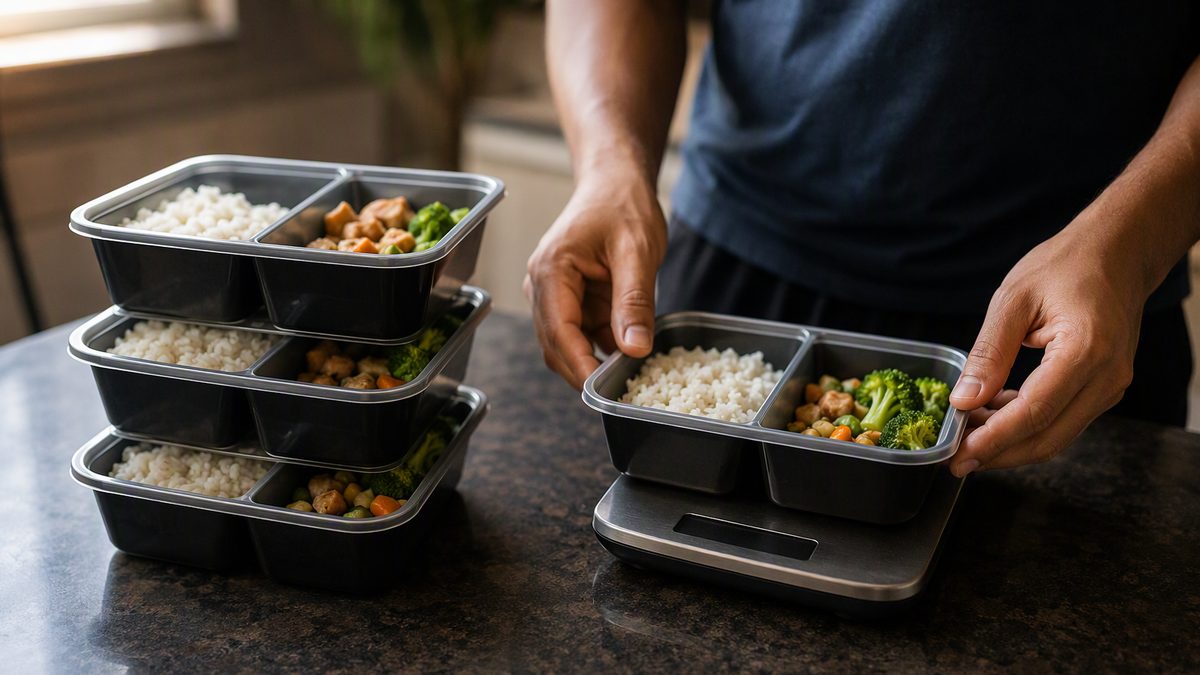
💡 Key Takeaways
- Meal prep makes macro tracking easier because you log a recipe once and eat it many times; most of the effort is in the first Sunday.
- Weigh ingredients raw, log the whole batch, then divide by the number of portions; cooked weights mislead because rice and dal absorb water.
- Cooking oil and ghee are the most common hidden calories in Indian batch cooking; measure them with a spoon every time.
- A review of self-monitoring studies found that tracking food intake is consistently linked with greater weight loss, so keeping the habit matters more than perfect accuracy.
1. How do you track macros when you meal prep?
Weigh the raw ingredients, add them to one saved recipe in your tracking app, set the number of servings, and log a serving each time you eat. That is the whole system. Meal prep is the easiest way to track macros because one careful session on Sunday replaces dozens of rough guesses at lunch and dinner.
The reason to log raw is that cooked weights change. Rice and dal absorb water, vegetables lose it, and chicken shrinks. A cup of cooked dal has fewer calories per gram than dry dal, because the water adds weight but no calories. If you weigh cooked food and look it up as a dry entry, you will overcount, because the water weight is billed as if it were dry food. If you weigh dry food and look it up as a cooked entry, you will undercount.
The method is straightforward: weigh the dry rice, dal, paneer, soya chunks or raw chicken before cooking, enter them as a recipe, weigh the finished pot, and divide. The five habits below make that routine fast. For a general introduction to why tracking helps, our beginner's guide to tracking macros for fat loss covers targets and calories.
2. Hack 1: Weigh the whole batch, then divide
After cooking, put the empty pot on the scale, tare it, then pour in the finished food and note the total weight. Divide by the number of portions you want. If a batch of rajma comes to 1,800 g and you want six portions, each is 300 g, and you can use the same 300 g scoop all week.
This avoids the problem of eyeballing the first portion generously and the last portion stingily. It also lets you adjust: if one portion should be bigger for a heavy training day, simply weigh out 400 g and log it as one and a third servings.
The macros per portion then come from the recipe total divided by six, whatever the cooked weight. Do not weigh a portion and then try to calculate from the raw numbers again; the saved recipe has already done the work.
3. Hack 2: Measure the oil, ghee and masala base
Fat is the largest source of unlogged calories in home cooking. One tablespoon of oil or ghee contains roughly 120 kcal, because fat provides about 9 kcal per gram and a tablespoon holds around 13 to 14 g. A curry made with three "glugs" of oil can quietly add 400 kcal to the batch, divided across six portions, that is 60 to 70 kcal each.
For high-protein prep, measure oil with a spoon, not by eye. A non-stick pan lets you cut it down to a teaspoon or two for dal tadka or palak paneer. Cream, cashew paste, coconut milk and fried onion gravy also add calories that a quick "dal" entry in an app will not capture. If you use a ready-made entry, edit it to match your recipe.
The same goes for "free" extras like sugar in chai, the roti's ghee and the handful of peanuts on poha. They are small individually and large together. Our calories and protein chart for Indian foods is useful for checking typical values.
4. Hack 3: Prep components, not just full meals
Prepping complete meals gets boring by day four. A flexible alternative is to cook components and assemble them: a protein, a carbohydrate and a vegetable base. For example, a pot of dal, a tray of tandoori-style paneer or chicken tikka, boiled eggs, cooked rice, and chopped sabzi. You can mix them in different ways through the week.
The macro maths stays simple because each component has its own saved entry. A typical lunch becomes "150 g rice, 200 g dal, 100 g paneer tikka" and you can adjust the numbers based on hunger or training. This works well for people who need to vary calories between training and rest days.
Keep to three or four protein options at a time, such as soya chunks, paneer, eggs and chicken. If you want recipes that freeze and reheat well, see our cook-once high-protein Indian meal prep recipes.
Food safety matters in warm weather. Cool cooked food quickly, refrigerate within about two hours, and eat refrigerated cooked rice and dal within three or four days. If your fridge is small or the power cuts out often, prep for three days, not seven, and freeze the rest.
5. Hack 4: Use standard containers and a repeat menu
Using the same containers makes portions nearly automatic. If a 750 ml box holds one portion of your rice-and-dal lunch, you only weigh it once to check. Fill the box, close it, and log the saved meal. Over a week you can skip the scale for those meals and use it only for new recipes.
A short menu of repeating meals helps more than most people expect. Many people who track successfully eat the same breakfast and lunch on weekdays and vary only dinner and weekends. Fewer decisions mean less logging, and your saved recipes cover most of the week. Variety can come from changing the sauce or the vegetable while keeping the base and its macros constant.
This also reduces the pull of ordering in. If you have a plan, a prepared lunch and a saved entry, you are less likely to default to delivery. For a realistic view of eating out and mixed plates, see macro tracking for real life.
6. Hack 5: Add a buffer, then review weekly
Plan to land a little under your calorie target on prepared days, about 100 to 150 kcal, to leave room for the unplanned bite: a samosa at work, a second roti, a piece of mithai at a family event. Perfect tracking is not possible, and a small buffer stops one slip from derailing the week.
At the end of the week, compare the average of your logged days against what actually happened to your body weight. A trend taken over two or three weeks, such as the average of your daily weights, is the check that matters. If your weight is not moving as expected and you are logging consistently, the first thing to examine is hidden fat and portion drift, as described above; the second is whether your calorie target is realistic. Adjust by 100 to 200 kcal, not by half.
Review of the research supports sticking to the habit. A systematic review of self-monitoring in weight loss (Burke and colleagues, 2011) found that self-monitoring of diet was consistently associated with weight loss. These were mostly observational and intervention studies of mixed quality, and cannot prove tracking itself caused the loss, since motivated people may both track and lose weight. It is still the best case for a simple routine you can keep.
7. Common mistakes when tracking prepped food
- Logging cooked rice with a raw rice entry. Check which state the database entry refers to.
- Forgetting the portion count. If you change the number of portions, the per-serving macros change too; update the recipe.
- Not weighing the finished batch. A recipe made with a different amount of water will have different weight per portion.
- Mixing up brands. Soya chunks, paneer and curd vary between brands. Use the numbers on your own packet.
- Overcomplicating things. Tracking 90 percent of your food accurately and the rest roughly is better than quitting after a week.
If you eat vegetarian and want to hit protein targets with prepared food, the cook-once recipes and the protein chart are good starting points. If you also want to know how much of the daily total each meal should carry, our daily protein guide sets the numbers.
Related reading
8. Frequently Asked Questions
Q1: Should I weigh food raw or cooked for macro tracking?
A1: Raw is more reliable, because cooking changes weight through water gain or loss but not calories. Weigh the raw ingredients, save them as a recipe, and weigh the whole finished batch to divide it into portions. If you weigh cooked food, use a database entry that says cooked.
Q2: How long does prepped Indian food last in the fridge?
A2: As a general food-safety guide, cooked rice, dal and curries keep for about three to four days in a cold fridge, and longer in the freezer. In hot weather cool food quickly and refrigerate it within a couple of hours. When in doubt, throw it out.
Q3: How accurate does macro tracking need to be?
A3: Close enough to be consistent. Errors from restaurant meals and cooking oil are normal. What matters is that your average intake over weeks is near your target, so check your weight trend and adjust if it is not moving.
Q4: Do I need to track forever once I start meal prepping?
A4: No. Many people track strictly for a few weeks to learn portion sizes and the calories in common dishes, then track loosely or only on some days. If your weight and training go as planned, you can reduce the logging.
Scientific References & Clinical Sources
- Burke LE, Wang J, Sevick MA. Self-monitoring in weight loss: a systematic review of the literature. J Am Diet Assoc, 2011. PMID: 21185970
UltraFit360 brings your workouts, nutrition and wearable data together. See how the AI fitness tracker works with Apple Health and Health Connect.