💡 Key Takeaways
- Good running form mostly means landing with your foot close to under your body, running with quick light steps, and staying relaxed; there is no single perfect style.
- In a lab study, raising step rate by 5 percent reduced knee loading, and 10 percent reduced hip loading as well; it is a reasonable first change for many overstriders.
- Changing from heel to forefoot striking shifts load rather than removing it, so make that change slowly if at all.
- Most running injuries are linked to doing too much too soon, so build mileage gradually and add calf and glute strength work.
1. What does good running form look like?
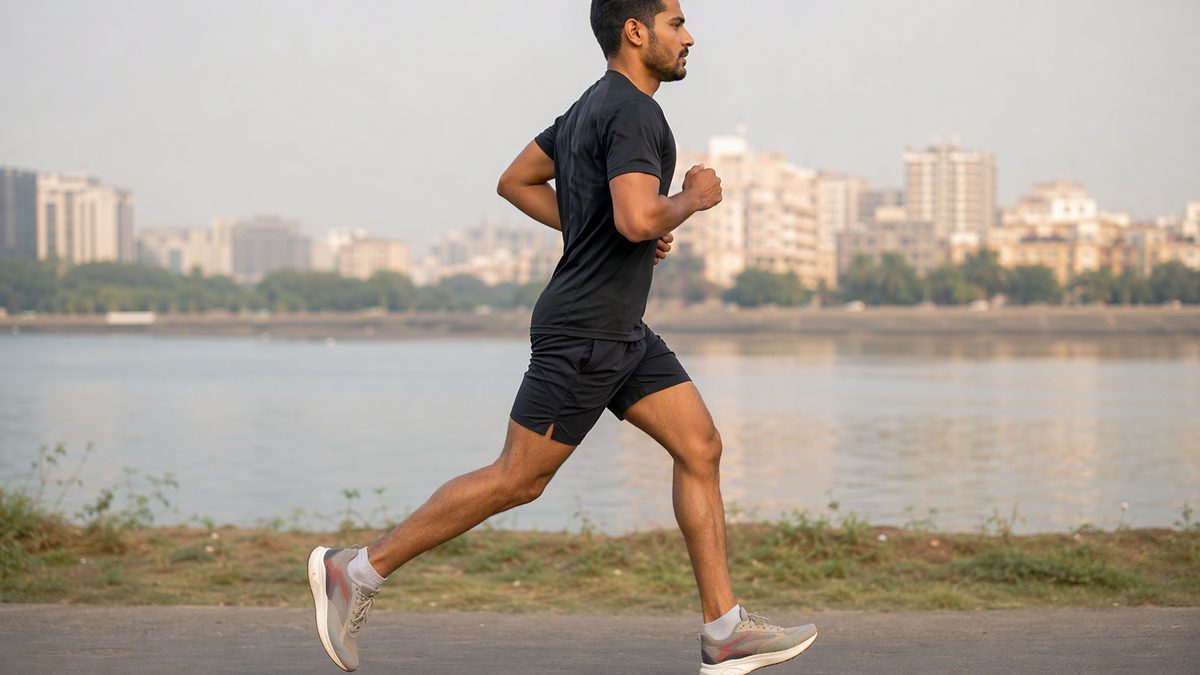
Good form is running that feels smooth and quiet, with your foot landing close beneath your hips, your torso tall, and your arms and shoulders relaxed. There is no one ideal technique, because the best style for you depends on your body, speed and training history, and most runners settle into an efficient pattern on their own with practice.
Several features show up repeatedly in coaching and research:
- Foot landing near your centre of mass. Landing far ahead of your body acts like a brake and sends a bigger shock up the leg. This is called overstriding.
- A quicker, lighter step rate. Taking more, shorter steps usually reduces how far in front you land.
- A tall, slightly forward posture. Lean from the ankles, not the waist, so your hips stay under your shoulders.
- Relaxed arms. Elbows near 90 degrees, hands loose, swinging forward and back rather than across the body.
- Quiet feet. A loud slap can be a sign of heavy landing.
If you are new to running, the couch to 5K guide covers how to build up the volume before you worry about form details.
Think of form as something you refine, not something you impose. If a change makes running feel harder or produces new aches, it is probably not right for you at that time, and going back to your natural pattern is a perfectly good decision. Form tends to improve most as a side effect of getting fitter, stronger and more relaxed rather than from conscious correction mid-run.
2. What is the best cadence for running?
There is no universal best cadence. You will often hear 180 steps per minute, but that number comes from observations of elite runners at fast speeds, and your ideal rate depends on your height, leg length and pace. Most recreational runners run somewhere between roughly 150 and 180 steps per minute at easy speeds.
What does have evidence behind it is the effect of a modest increase. Heiderscheit and colleagues (2011) had runners increase their step rate by 5 and 10 percent while keeping speed constant, and measured joint mechanics in the lab. A higher rate shortened the step length. A 5 percent increase reduced the energy absorbed at the knee, and a 10 percent increase reduced it at the hip as well, which are the joints that take the load when you land. The study was done on 45 healthy runners in a lab, and it measured loads rather than injuries, so it does not prove that cadence changes prevent injury. It does give a sound reason to try a small increase if you overstride.
To try it, find your current cadence (many watches and phone apps show it), then raise it by 5 percent over several runs. Use a metronome app or music at the right beat. If your cadence is already high for your speed, there is no reason to push it further.
3. Should you land on your heel, midfoot or forefoot?
For most runners, it is not necessary to change how your foot first touches the ground. A large share of shod distance runners land on the heel or midfoot, and plenty of them run well and uninjured. Where you land matters less than how far in front of your body you land and how much force you absorb.
Lieberman and colleagues (2010) compared habitually barefoot runners with shod runners. The barefoot group tended to land on the forefoot or midfoot and showed lower collision forces than heel-striking shod runners. That is an interesting finding, but it is a comparison of groups with different histories, and it does not show that switching your landing pattern will make you less injury-prone. Shifting from heel to forefoot also moves more load to the calf and Achilles tendon, which can cause new problems if you change too quickly.
A sensible approach is to focus on the overstride rather than the heel. Land closer to your body with a slightly bent knee and quicker steps, and your foot strike will often adjust itself. If you want to try more forefoot landing, spend a few weeks adding a small share of each run, and build calf strength first.
4. How do you check and improve your own form?
A phone video is enough to spot the biggest issues. Ask a friend to film you for 20 seconds from the side and from behind while you run at your normal easy pace, ideally on a treadmill or a quiet straight road. Slow the footage down and check these points:
- Where does your foot land relative to your hips? If it lands well ahead of your knee, try shorter steps.
- Do your hips drop or collapse sideways? That can point to weak glute muscles.
- Does your head bob or your shoulders shrug? Excess upper body movement wastes energy and signals tension.
- Do your knees cave inward on landing? Strength and balance work can help.
Change one thing at a time and only for a short part of your run at first. Trying to fix posture, cadence and foot strike at once usually makes you stiffer and slower. Our mobility and flexibility guide helps if tight hips or ankles limit your stride.
If you have persistent pain in the knee, shin, heel or hip, get it assessed by a physiotherapist rather than trying to fix it with form changes alone.
Short strides after an easy run, which are 15 to 20 seconds of fast but relaxed running with full recovery, are a gentle way to practise good mechanics at higher speed. Hill repeats do something similar by naturally shortening your stride and encouraging a tall posture, with less risk than flat sprinting.
5. Does better form make you more efficient?
Efficiency, usually called running economy, is how much oxygen you use at a given pace. It improves with training volume, strength work, and a good fit between your body and running style. Studies of experienced runners often find that the style they pick naturally is close to their most economical one, which is another reason not to over-engineer your technique.
The biggest efficiency gains for most people come not from form drills but from consistent aerobic training and strength. Heavy or explosive lifting, hill sprints and plyometrics have been associated with improvements in economy in trained runners, though results vary between studies and people. A weekly session of squats, lunges, calf raises and single-leg work makes sense alongside your runs. See strength training fundamentals for how to start.
Intensity also matters. Mixing easy runs with some tempo work and intervals improves speed, but only a minority of runs need to be hard. Our guides to heart rate zones and HIIT versus LISS explain how to balance them.
6. How can you prevent running injuries in Indian conditions?
The most consistent pattern in running injury research is training load: people get hurt when they raise distance or intensity faster than their tissues adapt. The popular "10 percent a week" rule is a convenient guide, but it is not strongly supported as a safe limit, so use it as a rough ceiling and take a lighter week every third or fourth week.
Some practical points for road running in India:
- Watch the surface. Roads are often cambered, footpaths are uneven and tiles or concrete are hard. Alternate surfaces where you can, and use a park or track for some runs.
- Run early or late in hot months. Heat raises effort and dehydration risk; see our electrolyte and hydration guide for how to drink and when to add salt.
- Watch the footing in the monsoon. Wet roads, painted lines and manhole covers are slippery; shorten your stride and slow down.
- Match your shoes to your running. Worn-out or poorly fitting shoes add to the problem; read the running shoes selection guide.
- Strengthen calves, glutes and hips twice a week, and rest when pain lasts more than a few days or alters your stride.
Anyone with pain that persists, swelling, or pain at night should see a doctor or physiotherapist.
Related reading
7. Frequently Asked Questions
Q1: What is the ideal running cadence?
A1: There is no single ideal number. Most recreational runners fall between about 150 and 180 steps per minute at easy pace. If you overstride, raising your cadence by 5 to 10 percent is a reasonable thing to try.
Q2: Is heel striking bad?
A2: Not by itself. Many healthy runners heel strike. The bigger issue is landing far in front of your body, which increases braking and impact. Fix the overstride first and see whether your foot strike changes naturally.
Q3: Should I run on my toes?
A3: Running on your toes is not recommended. A forefoot landing puts more load on the calf and Achilles tendon, and a sudden change often causes injuries. If you want to experiment, add it gradually over weeks.
Q4: How long does it take to change my running form?
A4: Small changes such as a higher cadence can feel natural within a few weeks of practice. Expect 4 to 8 weeks for new patterns to settle, and make changes during easy runs, not hard efforts.
Scientific References & Clinical Sources
- Heiderscheit BC, et al. Effects of step rate manipulation on joint mechanics during running. Med Sci Sports Exerc, 2011. PMID: 20581720
- Lieberman DE, et al. Foot strike patterns and collision forces in habitually barefoot versus shod runners. Nature, 2010. PMID: 20111000
Want a plan built around your training history? UltraFit360's free AI workout planner creates and adjusts programs for you.