💡 Key Takeaways
- You can run a 4 minute interval block at home with no equipment, using 20 seconds of hard work and 10 seconds of rest for 8 rounds.
- Pick a simple move per block and push it hard, because form falls apart quickly when you are tired; choose a low-impact one if you are new, heavy or in a flat.
- A home bodyweight session is good interval training but gentler than the original lab protocol, so progress by raising effort or adding blocks rather than adding complicated moves.
- Two or three short sessions a week, with a proper warm-up and a day between them, is enough for most people.
1. How do you do a Tabata workout at home with no equipment?
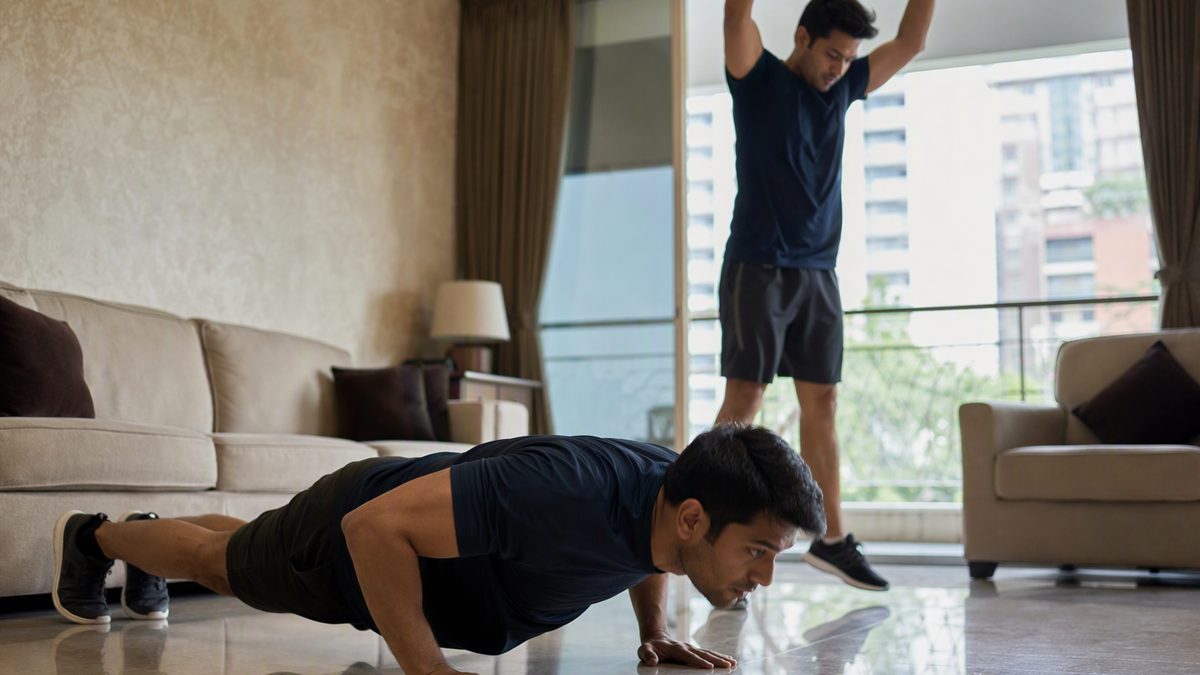
Set a timer for 8 rounds of 20 seconds of hard work and 10 seconds of rest, choose one movement you can do fast without losing control, and repeat it for all 8 rounds. That is a 4 minute block, and you can do it in a small room without anything but a floor and a phone timer.
The pattern comes from a 1996 study on cycle ergometers, which we explain in our guide to the Tabata protocol and its evidence. The short version is that the research used a very hard effort on a bike, and bodyweight moves at home are usually less intense than that. So treat these sessions as high-intensity interval training in the Tabata format, not as a copy of the study. They are still a good use of 15 minutes if you push honestly.
Before you begin, warm up for 5 to 8 minutes: march on the spot, do arm circles, bodyweight squats, hip hinges, and a few progressively faster bursts. Cold muscles and a sudden max effort are how people tweak hamstrings and knees.
2. Five home Tabata blocks, from simplest to most demanding
Each block below is one 4 minute round. Choose one for a short session, or combine two or three with 1 to 2 minutes of rest between blocks for a longer workout. The ranking is by how demanding they are on breathing and joints; if you are new, heavy or in a flat, choose fast bodyweight squats or mountain climbers, because high knees, squat jumps and burpees all load the joints with impact. Multi-block sessions are a home high-intensity interval variant, not the original protocol, which was a single block.
| Block | The move | Why use it | Watch out for |
|---|---|---|---|
| 1. High knees | Run in place, driving knees to hip height | Low skill, raises heart rate fast | Impact on knees and ankles; land softly on the balls of the feet |
| 2. Fast bodyweight squats | Squat to parallel and stand quickly, no jump | Big muscles, easy on the knees if controlled | Knees caving in; keep them tracking over the toes |
| 3. Mountain climbers | Plank position, drive knees to chest alternately | Trains legs, core and shoulders together | Sagging hips or hands too far forward |
| 4. Squat jumps | Squat down, jump up, land softly and go straight into the next | Higher power output than plain squats | Impact on knees and ankles; skip if you are heavy or deconditioned |
| 5. Burpees | Floor, push-up (optional), jump up | Whole body, very demanding | Back sagging in the plank; step back instead of jumping if needed |
If you are new to intervals, begin with block 2 and stay there for two weeks. The goal is to feel that you cannot easily keep the same pace by round 6 or 7. If you can, speed up or move to a harder block rather than adding more complicated variations.
For a gentler way to combine movements into a full session, our bodyweight full-body workout and no-equipment home workout plan pair well with a Tabata block at the end.
3. Making it hard enough to count
The most common mistake at home is working at a pace you could hold for several minutes. A 20 second effort should be fast enough that the last 5 seconds feel hard to complete, and by round 6 or 7 your output should visibly drop. If it does not, you have room to push.
Three practical ways to raise the intensity without making the move unsafe:
- Move faster, not wider. Increase the speed of each repetition and keep the range of motion controlled. Quick, tidy reps beat sloppy ones.
- Count repetitions. Counting the reps in each round gives you a score. If round 1 is 22 squats and round 8 is 14, you worked hard. Aim to beat the total next time.
- Keep the rest at 10 seconds. That is already tight and should not be shortened further. Lengthen it to 20 seconds if your form breaks down.
Do not use a heart rate number from a wrist tracker as your only guide. Optical sensors lag behind during short bursts, so your watch may show a lower number than your true peak. Perceived effort is more reliable for 20 second intervals. For longer intervals where heart rate monitoring works well, see our explanation of heart rate zones.
4. Apartment, heat and neighbour practicalities
Home training in a flat has its own problems, and a little planning solves most of them. Jumping moves like squat jumps and burpees are loud for the neighbours below. A thick exercise mat, a folded yoga mat under a rug, or choosing a low-impact block such as fast squats or mountain climbers keeps the noise down. Do not exercise barefoot on a slippery tiled floor; wear shoes with grip, or use a non-slip mat.
Heat and humidity matter more than people expect. In many Indian cities, a closed room in summer can be above 30 degrees Celsius, and a hard 4 minute block raises your body temperature quickly. Use a fan, train in the cooler morning or late evening, keep water within reach, and stop if you feel dizzy, nauseated, or have a pounding headache. After a session, drink to thirst and eat a normal meal with some protein, such as dal, eggs, curd, or paneer, rather than assuming the workout needs a special supplement.
Finally, do not do intervals on a full stomach. A light snack an hour or two before is fine, but a heavy lunch followed by burpees is a poor mix.
5. Cooling down and what to eat afterwards
Finish every block with 3 to 5 minutes of walking so your heart rate comes down gradually. Stopping dead after a maximal effort can leave you light-headed because blood pools in the legs. Once you feel normal, a few gentle stretches for the calves, quadriceps, hip flexors and shoulders are enough; long, deep stretching is not necessary.
You do not need a special recovery product. A normal meal within a couple of hours that contains protein and carbohydrate does the job, for example eggs and toast, dal with rice and curd, or paneer with roti. Sleep is where adaptation happens, so keep the session at least a few hours before bedtime if intervals leave you wired. If you notice that you are sore for more than two days, your resting heart rate is up, or you dread each session, reduce to one block and take an extra rest day before you build up again.
6. How often to train, and how to progress
Two or three Tabata-style sessions a week is enough for most people, with at least one day between them. Because these efforts are demanding, they should sit alongside strength work and easier cardio, not replace them. A sample week for a healthy beginner could look like this:
- Monday: Strength training or a full-body bodyweight session.
- Tuesday: One 4 minute Tabata block after a warm-up, then a 20 minute walk.
- Wednesday: Rest or an easy walk.
- Thursday: Strength training.
- Friday: Two Tabata blocks with a 2 minute rest between them.
- Saturday: A longer, easy aerobic session such as a Zone 2 walk.
- Sunday: Rest.
If you are new to intervals, build up the work-to-rest ratio first: weeks 1 to 2 use 30 seconds on and 60 seconds off, weeks 3 to 4 use 20 seconds on and 20 seconds off, and the full 20 on and 10 off starts from week 5. After that, add one block before you make any single block harder, and stop at three blocks in a session. Past that point, quality drops and injury risk rises. After four to six weeks, change the move rather than keeping the same one forever, which also keeps the session interesting.
If you are comparing this with other interval formats, our HIIT and LISS comparison explains where short blocks fit alongside steady-state work.
7. Who should be careful with this kind of session
Hard intervals are not appropriate for everyone without checking first. Speak to a doctor before starting if you have heart disease or a family history of early heart problems, high blood pressure that is not well controlled, diabetes with complications, are pregnant, have recently had surgery or an injury, or experience chest pain, dizziness or unusual breathlessness when you exercise. Stop immediately if you feel chest tightness, faintness, or sharp joint pain.
People who are very overweight, who are older, or who have not exercised in years can still do intervals, but should begin with gentler versions such as 30 seconds of brisk marching and 60 seconds of slow walking, and avoid jumping. The point of interval training is a manageable challenge repeated consistently, not a maximum effort that you dread and abandon after two weeks.
Related reading
8. Frequently Asked Questions
Q1: Can I do Tabata at home without equipment?
A1: Yes. Pick one simple move such as fast squats, high knees or mountain climbers, work hard for 20 seconds, rest 10 seconds, and repeat for 8 rounds. Warm up first and use a timer.
Q2: Is a bodyweight Tabata as effective as the original study?
A2: Not necessarily. The 1996 study used a cycle ergometer at a very high intensity, which is hard to match with bodyweight moves. Home sessions are still useful interval training if you push hard enough that your output drops by the later rounds.
Q3: How many Tabata rounds should a beginner do?
A3: Start with one block and a lower-impact move, and build up the work-to-rest ratio: weeks 1 to 2 use 30 seconds on and 60 seconds off, weeks 3 to 4 use 20 seconds on and 20 seconds off, and the full 20 on and 10 off starts from week 5. Add a second block only after a few weeks of consistent, comfortable sessions.
Q4: What is the best Tabata exercise for fat loss?
A4: No single exercise is best, and a 4 minute block burns relatively few calories. Fat loss depends mostly on overall diet and weekly activity, so choose moves you can do safely and consistently, and combine them with walking and strength training.
Scientific References & Clinical Sources
- Tabata I, et al. Effects of moderate-intensity endurance and high-intensity intermittent training on anaerobic capacity and VO2max. Med Sci Sports Exerc, 1996. PMID: 8897392
- Buchheit M, Laursen PB. High-intensity interval training, solutions to the programming puzzle: Part II: anaerobic energy, neuromuscular load and practical applications. Sports Med, 2013. PMID: 23832851
Want a plan built around your training history? UltraFit360's free AI workout planner creates and adjusts programs for you.