💡 Key Takeaways
- A smart ring estimates heart rate, heart rate variability, skin temperature trends, movement and sleep from your finger; it does not measure blood pressure, glucose or diagnose illness.
- Rings are most useful for overnight trends in resting heart rate, HRV and sleep timing, and least reliable during intense or grip-heavy exercise.
- Sleep stage labels are estimates; sleep and wake timing is more dependable than the split between light, deep and REM.
- Judge a ring by whether it changes a decision, such as an easier day after several poor nights, not by the daily score.
1. What does a smart ring actually measure?
A smart ring measures pulse and movement at the finger and uses them to estimate heart rate, heart rate variability, breathing rate, skin temperature changes and sleep. It does not read blood pressure, blood glucose or blood oxygen the way a clinical instrument does, and it cannot diagnose a medical condition.
Most rings use three sensor types. A small LED and light sensor on the inside of the band performs photoplethysmography: it shines light into the finger and detects the tiny changes in reflected light as blood pulses through the vessels. From the timing of each pulse the device calculates heart rate and the beat-to-beat variation that gives HRV. A thermistor measures skin temperature on the finger. An accelerometer records movement, which is used for step counts, activity and, in combination with heart rate, for judging whether you are asleep.
Everything else is software built on those three signals. Recovery scores, readiness scores, stress scores and sleep stage charts are the maker's own models, and the way they are calculated differs between brands and is rarely published in full. That is worth remembering when two devices give you different numbers for the same night: neither is a measurement of a clean physical quantity.
2. What are smart rings good at, and where do they fall short?
Rings do best when you are still. The finger has good blood flow and is a convenient place to read the pulse overnight, when movement is low and conditions are repeatable. That is why most of the useful data is from sleep: resting heart rate, the HRV average across the night and the timing of when you fell asleep and woke.
They struggle when you move. Gripping a barbell, a kettlebell or a pull-up bar compresses the finger and changes blood flow, and rapid hand movement makes the optical signal noisy. Heart rate during interval training, strength sessions and cycling on rough roads is therefore less reliable than from a chest strap, which reads the heart's electrical signal. For steady running and walking rings can be adequate, and some people find them acceptable for zone training, but if training zones matter to you, a chest strap is the safer choice. Our guide to heart rate zones explains why.
Reviews of consumer wearables (de Zambotti and colleagues, 2019, on sleep technology; Peake and colleagues, 2018, on devices used in active populations) make a consistent point that applies to rings too: these devices are reasonable at detecting sleep versus wake, and weaker at telling sleep stages apart when compared with laboratory sleep studies, and their accuracy depends on the device and the activity. A study of the Oura ring in 41 healthy adolescents and young adults (de Zambotti and colleagues, 2019, in Behavioral Sleep Medicine) found 96 percent sensitivity for detecting sleep, but only 48 percent specificity for detecting wake, and agreement of 51 to 65 percent for light, deep and REM sleep against laboratory polysomnography. The authors called the results promising but in need of further validation. Use the stage chart as a rough picture, not a verdict.
3. How should you read HRV, temperature and sleep data from a ring?
Look at your own baseline over weeks, not the number on any single morning. HRV varies a lot between people, so a figure that is high for one person is low for another, and the day-to-day swing is normal. What is informative is a sustained drop below your own usual range, often together with a higher resting heart rate, after hard training, poor sleep, illness, alcohol or a stressful week. Our HRV monitoring guide explains how to set that baseline.
Skin temperature at the finger is reported as a deviation from your own average, not as a core body temperature. It moves with room temperature, bedding, alcohol and the menstrual cycle, and may shift in the days around the onset of an infection, but a ring is not a thermometer and cannot tell you whether you have a fever. In Indian summers a hot bedroom will swamp small changes, so interpret it cautiously.
For sleep, the most reliable numbers are bedtime, wake time and total duration. Check whether your timing is consistent before reading anything into deep or REM minutes. If your routine is irregular, fix that first; our sleep analysis guide for athletes shows what to look at.
Be wary of treating any score as a training instruction. A low readiness score on a day you feel fine may mean you should warm up carefully and see how you feel; a high score does not cancel a poor night you can feel in your legs. The best use is to prompt a question, not make the decision.
4. Ring, watch or chest strap: which should you choose?
The right device depends on what you want to track. For overnight data, comfort matters more than anything: a ring is small and many people forget they are wearing it, which makes for better sleep data than a bulky watch. For training, a watch or a chest strap gives you more usable information.
| Need | Ring | Watch | Chest strap |
|---|---|---|---|
| Comfortable overnight wear | Strong | Fair; some find it bulky | Poor |
| Live heart rate during workouts | Limited; not a live display on most rings | Good for steady cardio, weaker in intervals | Best |
| Navigation, GPS, notifications | No or limited | Yes | No |
| Battery life | Typically days | Hours to days depending on model | Months |
| Strength training with grip | Can be uncomfortable; many people take it off | Fine | Fine |
For many people the sensible setup is a watch or no tracker during training and a ring only if sleep and recovery trends are the goal. If you are comparing specific models, our smart rings buying guide covers the main options, and WHOOP versus Oura compares the two best-known recovery-focused devices. Check each product's current price, whether it needs a paid subscription, and whether it syncs with the health app you already use.
5. Practical points before you buy or wear one
- Sizing. Rings are sized to the finger and fingers swell in heat, after training and with salty meals. Most makers offer a sizing kit; use it and measure at different times of day. A loose ring gives noisy readings.
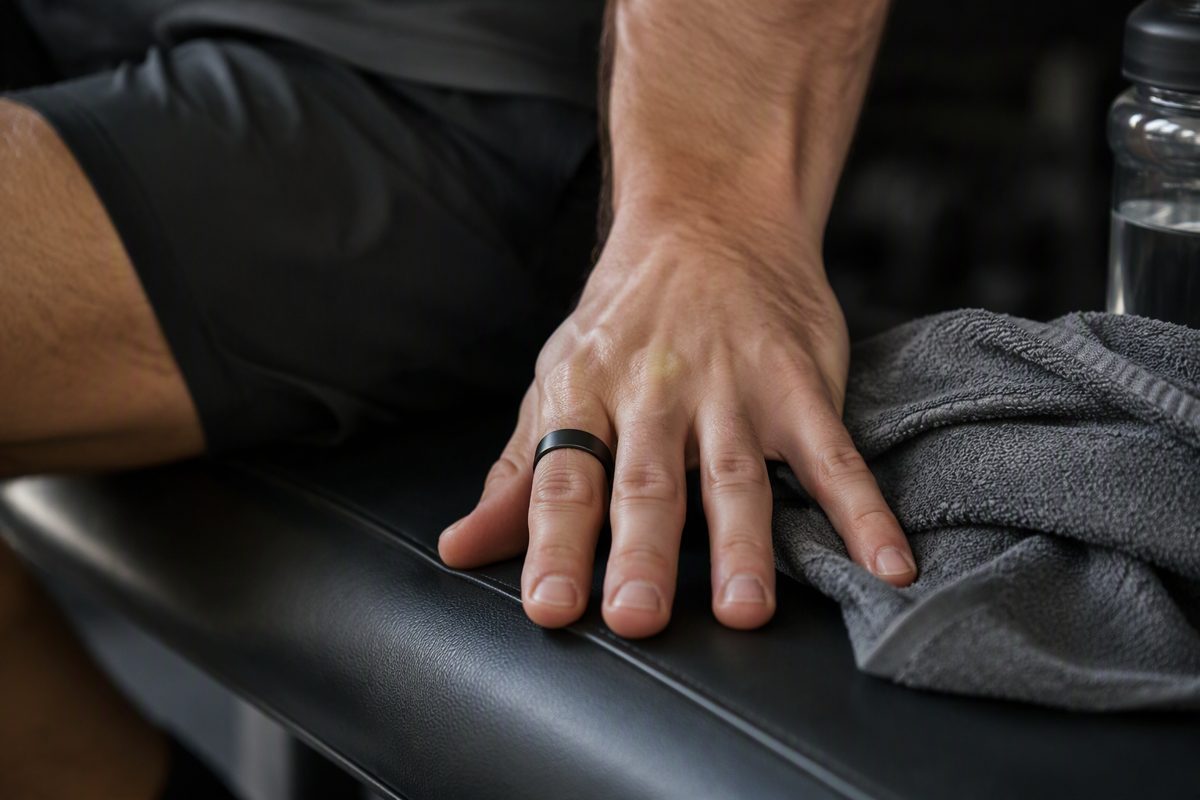
- Gym use. Heavy lifting can scratch the band and compress the finger. Many lifters wear it on a different finger or swap to a silicone band for sessions.
- Sweat and water. Check the water resistance rating, and rinse and dry the band if you train in humid conditions.
- Skin and fit. A tight ring for eight hours can irritate. Take it off if you notice redness or a rash.
- Data and privacy. The device sends your data to a company's cloud. Read what it collects and whether you can delete your account and data.
- Give it two to four weeks. Baselines take time to form, so early readings are less useful.
Whether you need one at all is a fair question. If you already sleep seven to nine hours at consistent times and feel recovered, a ring will mostly confirm what you know. People who benefit most are those with erratic schedules, high training loads or heavy work stress who want an objective prompt to ease off. Our wearables overview puts rings in the wider picture.
6. What rings cannot do, and when to see a doctor
A ring is a wellness device. Unless a product states a specific regulatory status for a specific feature in your country, treat its health alerts as prompts, not diagnoses. A persistently high resting heart rate, an irregular or racing pulse, chest discomfort, fainting or breathlessness need a medical assessment, whatever the app says. A normal-looking ring reading does not rule out a problem either.
The same applies to sleep. If a ring suggests you wake often, snore, or sleep badly for weeks while your habits are good, take that to a doctor rather than buying another device. Tracking can also backfire for people who become anxious about their scores; if checking the app starts to cause stress or poorer sleep, stop wearing it for a while.
Related reading
7. Frequently Asked Questions
Q1: Are smart rings accurate?
A1: It depends on what you measure. They are reasonable at resting heart rate and sleep versus wake timing while you are still, and weaker during vigorous or grip-heavy exercise and at labelling sleep stages. Compare your own trends over weeks instead of trusting any single number.
Q2: Can a smart ring measure blood pressure or blood sugar?
A2: No consumer ring measures either in a way you should rely on. Blood pressure and glucose need a cuff or a glucose sensor. Treat any such claim on a ring with caution and check the maker's stated regulatory status.
Q3: Is a smart ring better than a smartwatch for sleep?
A3: Many people find a ring more comfortable overnight, which can mean more complete data. That does not make its sleep staging more accurate than a watch. Both are estimates, so pick the one you will wear every night.
Q4: Can I wear a smart ring while lifting weights?
A4: You can, but gripping bars can compress the finger, scratch the band and add noise to the heart rate reading. Many lifters move it to another finger or remove it for sessions and wear it for sleep instead.
Scientific References & Clinical Sources
- de Zambotti M, et al. Wearable Sleep Technology in Clinical and Research Settings. Med Sci Sports Exerc, 2019. PMID: 30789439
- Peake JM, et al. A Critical Review of Consumer Wearables, Mobile Applications, and Equipment for Providing Biofeedback, Monitoring Stress, and Sleep in Physically Active Populations. Front Physiol, 2018. PMID: 30002629
- de Zambotti M, et al. The Sleep of the Ring: Comparison of the ŌURA Sleep Tracker Against Polysomnography. Behav Sleep Med, 2019. PMID: 28323455
UltraFit360 brings your workouts, nutrition and wearable data together. See how the AI fitness tracker works with Apple Health and Health Connect.