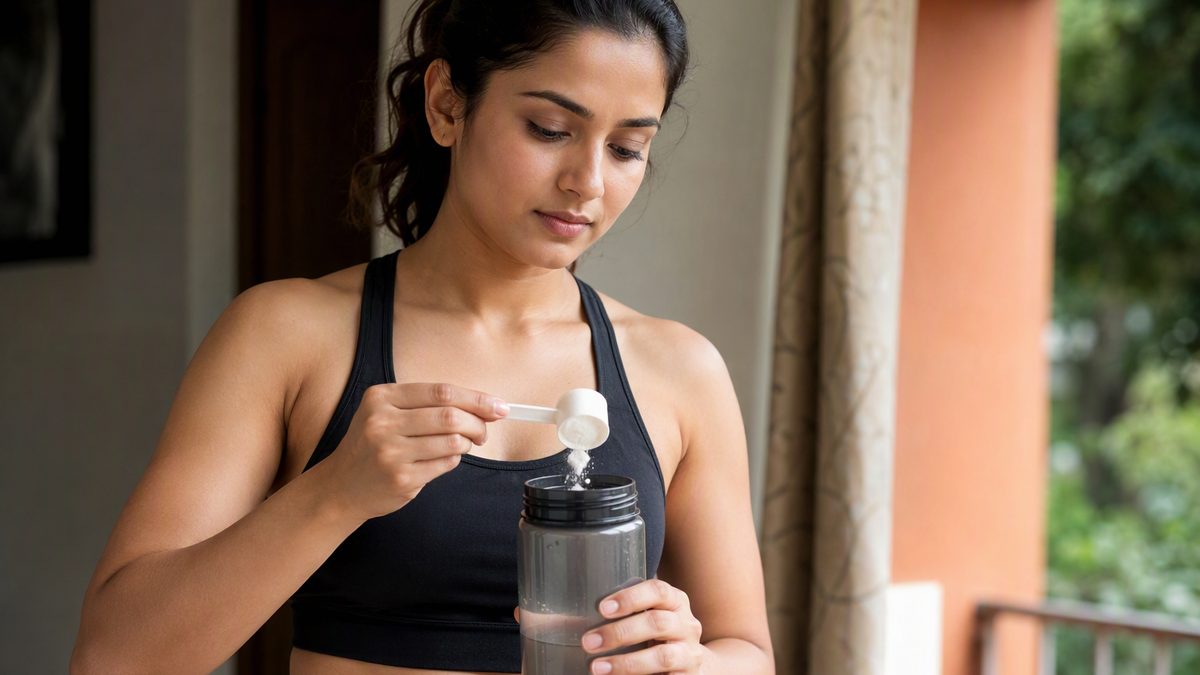
💡 Key Takeaways
- Creatine monohydrate is safe for healthy women at 3 to 5 g a day, and it helps strength and training volume in women much as it does in men.
- Women start with lower creatine stores, and vegetarian diets lower them further, so the effect can be larger for women who eat little meat.
- Expect 1 to 2 kg of water weight in the first weeks, mostly water in muscle, not fat gain.
- There is too little safety data for pregnancy and breastfeeding, so check with your doctor first; the same goes for kidney disease or antidepressant use.
1. Is creatine safe and effective for women?
Yes. For a healthy woman, 3 to 5 g of creatine monohydrate a day is safe, and it improves strength and the amount of work you can do in the gym, the same way it does for men. The International Society of Sports Nutrition position stand on creatine, which reviews the long-term safety data, found no meaningful harm in healthy people at these doses and no reason to treat women differently.
The honest caveat is that most of the research was done in young men. A 2021 review by Smith-Ryan and colleagues, written specifically about women across the lifespan, notes that female participants are under-represented and that some of its conclusions rest on small trials. The direction of the evidence is consistent, though: pre-menopausal women gain strength and exercise performance from creatine, and older women can gain muscle when creatine is paired with resistance training.
Creatine is not a stimulant, not a hormone and not a fat burner. It is a compound your body already makes and that you already eat in meat and fish. Supplementing simply tops up the stores in your muscles so that short, hard efforts, like the last two reps of a heavy set, have more fuel behind them. If you are not lifting or doing any form of hard training, the benefit is small, and the money is better spent on food. If you are, it is one of the few supplements with solid evidence behind it.
2. Why women may have more to gain
The Smith-Ryan review reports that women have somewhat lower creatine stores than men, partly because women carry less muscle on average. On top of that, creatine comes from the diet. A typical omnivore gets about 1 to 2 g a day from meat and fish. A woman who eats mostly dal, rice, vegetables and dairy, as many people in India do, gets close to none and relies entirely on what the liver and kidneys manufacture.
This is why vegetarian women often see a clearer response than meat-eaters. When baseline stores are lower, there is more room to fill. It does not guarantee a dramatic result, and some people respond very little, but the logic is sound and the trials in vegetarians back it up. If you follow a vegetarian pattern, our guide to creatine for vegetarians in India goes deeper on the diet side.
Practical expectations help here. Over four to eight weeks of consistent training and use, a woman might add an extra rep or two on main lifts, finish sessions less fatigued, and over several months build slightly more lean mass than with training alone. Nobody gets bulky from this. Building visible muscle takes years of hard training and a calorie surplus, and creatine does not change that arithmetic.
3. How much to take and how to take it
Use creatine monohydrate, the form with the most research, at 3 to 5 g a day. Some researchers prefer a bodyweight-based dose of about 0.1 g per kg, which works out to roughly 5 g for a 50 kg woman and 6 g for a 60 kg woman. Both approaches work, and 5 g is a sensible round number for almost everybody. Take it every day, including rest days, because the goal is to keep the stores full, not to time a spike.
You do not need a loading phase. Loading means 20 g a day split into four doses for 5 to 7 days, and it saturates the muscle faster, but 5 g a day gets you to the same level in about four weeks. Loading also tends to cause stomach upset and the sharpest early weight jump, which is the main thing women say they dislike. Our loading phase guide explains when it makes sense. For most women it does not.
- With food or after a meal: this lowers the chance of stomach discomfort.
- Mixed in plenty of water: about 200 to 300 ml, stirred well, since creatine monohydrate dissolves slowly.
- Check the label: it should say creatine monohydrate and nothing else, ideally with a third-party testing mark. Our piece on reading supplement labels in India shows what to look for.
- Skip the fancy forms: a comparison of options is in the best type of creatine.
You do not need to cycle on and off. There is no evidence that long-term use stops working or harms the body in healthy people, a point covered in our creatine cycling guide.
4. Will creatine make you gain weight or look bloated?
Creatine pulls water into muscle cells, so the scale often rises by 1 to 2 kg during the first two to four weeks. This is mostly water in muscle, not fat. It is also the main reason some women stop taking it, so it helps to know what to expect before the scale moves.
True bloating, meaning a puffy or distended stomach, is less common than the weight change and is usually tied to a large single dose, mixing the powder poorly, or taking it on an empty stomach. Splitting the dose, taking it with food and staying with 3 to 5 g solves most cases. Our dedicated guide on creatine bloating solutions walks through each fix.
Two timing details matter for women. First, weight naturally fluctuates by up to 1 to 2 kg across the menstrual cycle from fluid shifts alone, so a creatine-related gain can look worse in the week before a period. Judge changes by weekly averages, not single mornings. Second, measure waist and how clothes fit alongside the scale, because muscle water does not show up on a tape the way fat does.
5. Periods, pregnancy, perimenopause and mood
Menstrual cycle. Hormones affect how the body handles creatine, and some researchers speculate that supplementation may help in the low-hormone phase of the cycle. The evidence is too thin to build a plan around. Taking 3 to 5 g daily through the whole cycle is the practical answer, and you do not need to change anything by phase. If you want more on training around your cycle, see our piece on cycle syncing and training.
Pregnancy and breastfeeding. Creatine is made naturally in the body and is part of foetal development, but supplement trials in pregnant and breastfeeding women are essentially absent. Because the safety data does not exist, the cautious position is to avoid supplementing unless your doctor agrees.
Perimenopause and after. This is where the strongest female-specific data lives. In a 12-month trial by Chilibeck and colleagues (2015) of 47 postmenopausal women doing resistance training, those taking creatine (0.1 g per kg daily) lost less bone density at the femoral neck than those on placebo, and gained more bench press strength. A later meta-analysis from the same group of five trials, however, found no overall advantage for bone density, so the bone benefit is promising but not settled. Strength and lean mass gains are better supported. Our perimenopause strength training guide shows how to build the lifting that makes creatine worthwhile.
Mood. A small trial by Lyoo and colleagues (2012) added 5 g of creatine a day to an SSRI antidepressant in 52 women with major depression and saw faster improvement over 8 weeks. That is one trial and does not mean creatine treats depression. If you take antidepressants or have a mood disorder, talk to your prescriber before adding any supplement.
6. Hair loss, acne, kidneys and who should see a doctor first
The hair loss worry started from a single 2009 study in rugby players that measured the hormone DHT, not hair. A 2025 randomised trial (Lak and colleagues) in 45 resistance-trained men found that 5 g a day for 12 weeks did not change DHT or hair density, follicle counts or thickness. It enrolled men only, so there is no hair trial in women. We cover the details in the creatine and hair loss myth. In short, creatine has not been shown to cause hair loss.
Kidney fears are also overstated in healthy people. Creatine raises the blood level of creatinine slightly, which can make a lab test look worse without any actual kidney damage, so tell your doctor you take it before a blood test. Our kidney myths article explains why.
See a doctor before starting if any of these apply:
- You have kidney disease or reduced kidney function, or a family history of it.
- You are pregnant, trying to conceive or breastfeeding.
- You take medication that affects the kidneys, such as regular NSAIDs, diuretics or lithium.
- You have a diagnosed mood disorder and take medication for it.
For everyone else, a simple pattern works: 5 g of monohydrate daily with a meal, two to four resistance sessions per week, and enough protein. A woman weighing 60 kg doing regular strength work should aim for roughly 100 to 130 g of protein a day, from sources like paneer, dal, eggs, curd and whey if needed. Creatine supports training; it does not replace it.
Related reading
7. Frequently Asked Questions
Q1: How much creatine should a woman take per day?
A1: 3 to 5 g of creatine monohydrate daily is enough for most women, or about 0.1 g per kg of body weight. Take it every day, with food, and skip the loading phase unless you want faster saturation and can tolerate the stomach upset.
Q2: Will creatine make me bulky or fat?
A2: No. Creatine adds about 1 to 2 kg, mostly water in muscle, in the first few weeks, which is not fat and not visible bulk. Muscle size only changes meaningfully with months of hard training and enough food.
Q3: Is creatine safe during pregnancy or breastfeeding?
A3: There are not enough studies in pregnant or breastfeeding women to say it is safe, so the cautious answer is to avoid it unless your doctor agrees. Your body makes creatine on its own, and eating meat or fish supplies some.
Q4: Does creatine affect periods or hormones?
A4: Creatine is not a hormone and there is no good evidence that it changes cycle length or hormone levels. Weight can shift by a kilo or two across your cycle for unrelated reasons, so compare weekly averages before blaming the supplement.
Scientific References & Clinical Sources
- Smith-Ryan AE, et al. Creatine Supplementation in Women's Health: A Lifespan Perspective. Nutrients, 2021. PMID: 33800439
- Kreider RB, et al. International Society of Sports Nutrition position stand: safety and efficacy of creatine supplementation in exercise, sport, and medicine. J Int Soc Sports Nutr, 2017. PMID: 28615996
- Chilibeck PD, et al. Effects of Creatine and Resistance Training on Bone Health in Postmenopausal Women. Med Sci Sports Exerc, 2015. PMID: 25386713
- Forbes SC, et al. Creatine Supplementation During Resistance Training Does Not Lead to Greater Bone Mineral Density in Older Humans: A Brief Meta-Analysis. Front Nutr, 2018. PMID: 29740583
- Lyoo IK, et al. A randomized, double-blind placebo-controlled trial of oral creatine monohydrate augmentation for enhanced response to a selective serotonin reuptake inhibitor in women with major depressive disorder. Am J Psychiatry, 2012. PMID: 22864465
- Lak M, Forbes SC, et al. Does creatine cause hair loss? A 12-week randomized controlled trial. J Int Soc Sports Nutr, 2025. PMID: 40265319
Set your targets with the free calorie and macro calculator, then build a day of meals with the meal plan generator.