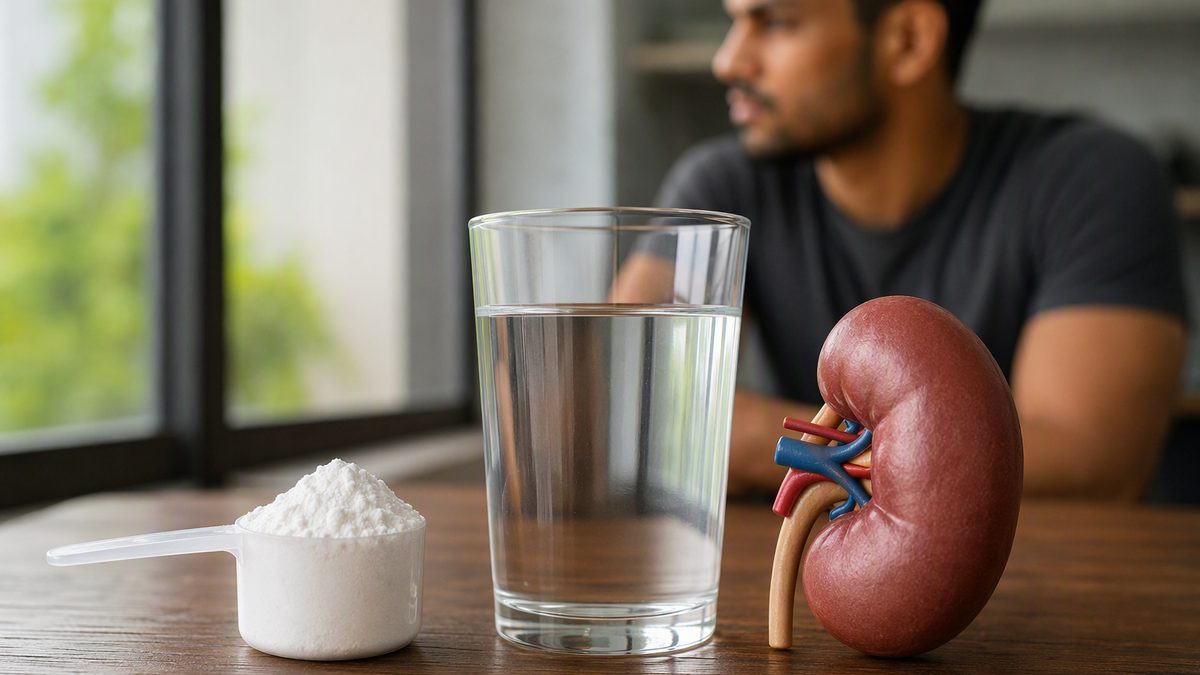
💡 Key Takeaways
- In healthy adults, studies lasting up to 21 months (randomised trials up to 12 weeks) have found no kidney damage from standard creatine doses of 3 to 5 g a day.
- Creatine raises blood creatinine slightly, which can make a routine kidney test look worse without any real loss of function; tell your doctor you take it.
- People with existing kidney disease, a single kidney, or on kidney-affecting drugs should get medical advice before using creatine.
- Long-term data beyond a couple of years is limited, so evidence is strong for safety in the short and medium term, not proven for decades.
1. Does creatine damage the kidneys?
In healthy adults, no. Controlled trials that measured kidney function directly, at standard doses of 3 to 5 g a day, have not found damage, and the main sports nutrition safety review concluded there is no evidence that creatine harms the kidneys of healthy people. The worry persists mainly because of a blood-test quirk and a handful of old case reports, both of which are explained below.
It is worth being precise about what that statement covers. It applies to people whose kidneys are working normally, at the usual doses, for the durations studied, which is mostly weeks to about two years. It does not mean creatine is risk-free for anyone with kidney disease, and it does not mean nobody could ever react badly. It means that if you are a healthy adult lifting weights, the kidney risk is not a good reason to avoid a supplement with otherwise strong evidence.
If you want the overall picture of creatine in India, including cost and choosing a brand, see our creatine guide for India. This article focuses only on the kidney question.
2. Where the kidney myth comes from: creatine versus creatinine
Two similar words cause most of the confusion. Creatine is the compound in your muscle and in the supplement. Creatinine is a waste product made when creatine breaks down, roughly 1 to 2 percent of the body's creatine pool each day, and it is excreted by the kidneys. Doctors use blood creatinine to estimate how well the kidneys filter, because if filtering slows, creatinine builds up.
If you take creatine, your body has a bigger pool and makes slightly more creatinine, so a blood test may show a mildly raised value. A doctor who does not know about the supplement may read that as reduced kidney function. In reality the filter is working normally; you have simply added more of the thing being measured. This is the origin of many scare stories, and of occasional reports of supplement users being told their kidneys look weak.
The reverse matters too. Muscular people already run higher creatinine than average, which is another reason a single value out of context can mislead. A more reliable cross-check is a different marker, cystatin C, which is much less affected by creatine intake and muscle mass. A urine test for albumin (protein leaking through the filter) is also unaffected by creatine. If you have a borderline result and take creatine, ask for one of these before drawing conclusions.
3. What the studies actually measured
Many studies only measured serum creatinine, which, as above, creatine can nudge. The more convincing ones measured filtration directly using a tracer, the gold standard.
- Lugaresi and colleagues (2013): a randomized, placebo-controlled trial in resistance-trained people eating a high-protein diet (at least 1.2 g per kg). They took 20 g a day for 5 days, then 5 g a day for 12 weeks. Glomerular filtration rate measured by 51Cr-EDTA clearance did not differ from placebo, and protein in the urine stayed normal. This directly addresses the common fear that creatine plus a high-protein diet is a risky mix.
- Gualano and colleagues (2011): a 12-week randomized trial in people with type 2 diabetes, a group already at higher kidney risk, who exercised throughout. Muscle creatine rose as expected, and measured kidney function was unchanged.
- Kreider and colleagues (2003): a 21-month study of 98 college football players, with blood and urine tested at nine time points across the study. Those taking about 5 g a day long-term showed no clinically significant changes across a 69-item panel of health markers, including kidney markers. It was open label and not randomized, so it is weaker evidence than the trials above, but it is one of the few studies running well beyond a few months.
- De Souza e Silva and colleagues (2019): a systematic review and meta-analysis of the literature, which concluded that supplementation did not induce renal damage at the amounts and durations studied. Small rises in creatinine appeared in pooled data, consistent with the measurement effect above rather than real injury.
An earlier review in Sports Medicine by Poortmans and Francaux (2000) reached a similar conclusion for the evidence available then: reports of harm were isolated, and controlled studies did not support a link.
4. The case reports, and what they do and do not show
A few published case reports describe kidney problems in people who took creatine, including one in the 1990s of a man with a pre-existing kidney condition. These are often quoted, but a case report cannot show cause. In most of them the person already had kidney disease, was taking other drugs such as anti-inflammatory painkillers, or used very large doses or contaminated products. That is why the reports are taken seriously for people with kidney disease, but a link has not been borne out when healthy people are studied in controlled trials.
Be honest about what we do not know. Studies are mostly in young, healthy participants for under two years. Decades of use in older people, in people with early undiagnosed kidney disease, and at very high doses are not well studied. Creatine is among the most-researched supplements in sport, yet absence of evidence of harm over that horizon is not proof of safety over a lifetime. That is a reason for sensible caution, not alarm.
Product quality is a separate risk. Powders from unknown sellers can be contaminated or under-dosed. Check labels and buy reputable brands; our guide on reading supplement labels in India explains what to look for.
5. Who should check with a doctor before using creatine
Creatine is cleared as creatinine by the kidneys, so anyone with reduced kidney function has less room for error. Speak to a doctor first if any of these apply:
- You have chronic kidney disease, kidney stones that recur, or only one kidney.
- You have diabetes or high blood pressure that has not been checked for kidney involvement. In India, many people with these conditions have not had a urine albumin or eGFR test, so it is worth getting one before starting.
- You take medicines that affect the kidneys: regular NSAIDs such as ibuprofen or diclofenac, diuretics, lithium, certain antibiotics, or some Ayurvedic preparations whose contents are unknown.
- Close family members developed kidney failure early.
- You are over 60 and have never had a kidney test.
For older adults with healthy kidneys, studies of creatine use are generally reassuring, and we discuss that in creatine for active seniors. The point is only to confirm the kidneys are healthy before you assume they are.
Seek medical care promptly if, while taking creatine, you notice swelling in the legs or around the eyes, much less urine than usual, foamy or blood-tinged urine, persistent nausea, or pain in the flank. These are not typical creatine effects and deserve a check regardless of what supplement you take.
6. How to use creatine in a kidney-conscious way
For a healthy person, the precautions are simple and do not need to be extreme.
- Stay at 3 to 5 g a day. There is no benefit in taking 10 g or more daily, and the loading phase is optional. If you are cautious, skip it, as discussed in our loading phase guide.
- Drink enough water. Creatine does not dehydrate you, but good hydration is a reasonable habit, especially in Indian summers when sweat losses are high. A rough guide is pale yellow urine through the day.
- Do not combine it with NSAIDs habitually. Regular painkiller use is a bigger kidney risk than creatine, and the two together make a test harder to interpret.
- Tell your doctor. Before any blood test, mention you take creatine and ask them to consider cystatin C or a urine albumin test if creatinine looks borderline.
- Keep protein sensible. About 1.6 to 2.2 g per kg is a common range for lifters. The Lugaresi trial suggests creatine plus a high-protein diet is fine in healthy people, but there is no extra benefit from going far above that.
- Get a baseline test. If you plan to take creatine for years, one set of kidney labs now gives you something to compare to later.
Creatine is also not the only supplement worth scrutinising. If you want a ranked look at what is worth buying at all, see our supplement guide.
Related reading
7. Frequently Asked Questions
Q1: Can creatine show up as kidney damage on a blood test?
A1: It can look that way. Creatine breaks down into creatinine, so your blood creatinine may be mildly higher even when the kidneys filter normally. Tell your doctor you take it, and ask whether cystatin C or a urine albumin test should be used to confirm.
Q2: Is creatine safe with a high-protein diet?
A2: In a 12-week randomized trial of resistance-trained people eating at least 1.2 g of protein per kg, measured kidney filtration did not change with creatine. That supports its safety in healthy people, though there is no need to push protein higher than your training needs.
Q3: Should I avoid creatine if I have diabetes or high blood pressure?
A3: Not automatically, but get a kidney check first, since both conditions can quietly affect the kidneys. A 12-week trial in type 2 diabetes found no change in kidney function, yet your doctor should confirm your own kidneys are healthy before you start.
Q4: How long can I take creatine safely?
A4: Studies of up to 21 months in athletes found no problems with health markers, and many people take 3 to 5 g daily for years. Data on decades of use is limited, so periodic checkups are sensible if you plan to continue indefinitely.
Scientific References & Clinical Sources
- Poortmans JR, Francaux M. Adverse effects of creatine supplementation: fact or fiction?. Sports Med, 2000. PMID: 10999421
- Gualano B, et al. Creatine supplementation does not impair kidney function in type 2 diabetic patients: a randomized, double-blind, placebo-controlled, clinical trial. Eur J Appl Physiol, 2011. PMID: 20976468
- Lugaresi R, et al. Does long-term creatine supplementation impair kidney function in resistance-trained individuals consuming a high-protein diet?. J Int Soc Sports Nutr, 2013. PMID: 23680457
- Kreider RB, et al. Long-term creatine supplementation does not significantly affect clinical markers of health in athletes. Mol Cell Biochem, 2003. PMID: 12701816
- de Souza E Silva A, et al. Effects of Creatine Supplementation on Renal Function: A Systematic Review and Meta-Analysis. J Ren Nutr, 2019. PMID: 31375416
- Kreider RB, et al. International Society of Sports Nutrition position stand: safety and efficacy of creatine supplementation in exercise, sport, and medicine. J Int Soc Sports Nutr, 2017. PMID: 28615996
Set your targets with the free calorie and macro calculator, then build a day of meals with the meal plan generator.