💡 Key Takeaways
- A loading phase of about 20 g a day for 5 to 7 days fills muscle creatine fast, but 3 to 5 g a day reaches the same level in roughly four weeks.
- Loading is optional; the end result at four weeks and beyond is the same either way.
- The main downsides of loading are stomach upset and a quick 1 to 2 kg water-weight jump, both avoidable by splitting doses or skipping it.
- Load only if you have a reason to want results within a week, such as an upcoming event, and split it into four 5 g doses with food.
1. Do you need a creatine loading phase?
No. Loading is a shortcut, not a requirement. Taking 3 to 5 g of creatine daily raises your muscle stores to the same level as loading does, it just takes about four weeks instead of one. If you are not in a hurry, skipping the loading phase costs you nothing in the long run and spares you the stomach discomfort some people get.
The key study behind this is Hultman and colleagues (1996), who gave creatine to 31 men in different patterns. Muscle total creatine rose by about 20 percent after 6 days at 20 g a day. A similar 20 percent rise was seen over 28 days at just 3 g a day, which is why the authors concluded that a low daily dose is likely as effective in the long term. The difference is speed, not the ceiling.
What loading buys you is time. If you start 5 g a day today, your muscles are close to full in about a month. If you load, they are full by next week. For someone who trains consistently for months, a three-week head start is rarely worth the side effects. For someone with a competition in ten days, it might be. This guide covers both sides so you can choose, and the rest of the article walks through how to do it properly if you decide to.
2. How to load: dose, split and duration
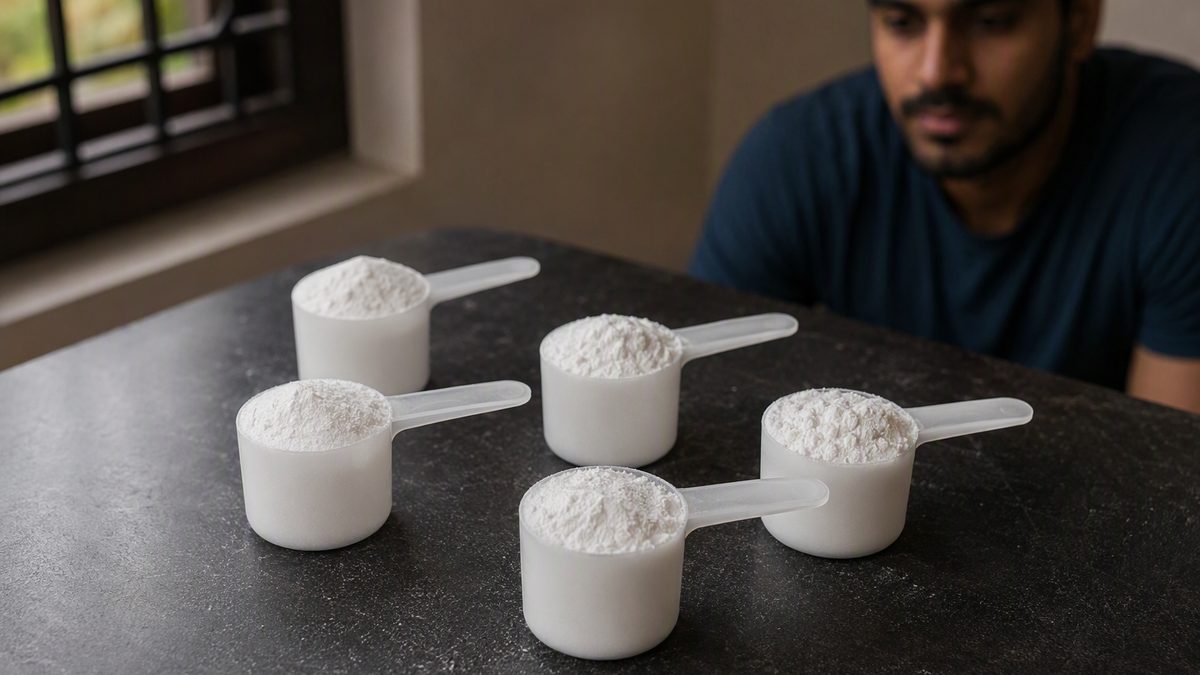
The standard method is 20 g a day for 5 to 7 days, divided into four doses of about 5 g spread through the day. Taking it in four portions keeps each dose small enough that the gut absorbs it comfortably. A single 20 g scoop is much more likely to cause diarrhoea or cramps.
| Approach | Daily dose | Time to full stores | Notes |
|---|---|---|---|
| Standard loading | 20 g in four 5 g doses | 5 to 7 days | Fastest; most stomach upset; then drop to 3 to 5 g |
| Bodyweight-based | About 0.3 g per kg, split | 5 to 7 days | Around 18 g for a 60 kg person, 24 g for 80 kg |
| Gentle loading | 10 g in two doses | About 2 weeks (an estimate, not a tested protocol) | Middle path with fewer side effects |
| No loading | 3 to 5 g once daily | About 4 weeks | Simplest; same result afterwards |
After the loading week, move straight to the maintenance dose. Hultman's work showed that 2 g a day held the loaded level, though most guidelines use 3 to 5 g, or about 0.1 g per kg of body weight, to allow for bigger people and training demand. The International Society of Sports Nutrition lists both loading and low-dose routes as valid.
Practical timing: put the four doses at breakfast, lunch, mid-afternoon and dinner, each with food. The exact hour does not matter much, a point discussed in creatine timing before or after a workout. Use creatine monohydrate; fancier forms do not load faster, as our comparison of creatine types explains.
3. Side effects of loading and how to avoid them
Most people tolerate loading well, but a minority have trouble. The usual complaints are stomach cramps, nausea, loose stools and a bloated feeling. They are dose-related: creatine that does not get absorbed draws water into the intestine, which is why a big single dose is worse than the same total spread out.
- Split the dose: four portions of 5 g, or even five of 4 g if you are sensitive.
- Take it with a meal: food slows gastric emptying and reduces irritation.
- Dissolve it fully: stir into 250 to 300 ml of water or juice until clear, since gritty undissolved powder irritates more. Micronized powder dissolves better.
- Drink water through the day: not because creatine dehydrates you, but because water helps the gut handle the load.
- Stop and switch to maintenance if symptoms are bad. You lose only speed, not eventual benefit.
Loading also causes a quick rise in scale weight, typically 1 to 2 kg in the first week, because creatine draws water in, mostly into muscle. This is not fat, and it settles into a stable level rather than continuing to climb. If it worries you, skipping the load spreads the same gain over a month so it is less noticeable. We cover this in creatine bloating solutions.
Heat matters in India. In hot weather, large doses and fluid shifts can feel worse, especially if you train outdoors or in a non-air-conditioned gym. Keep up with sweat losses; our electrolyte and hydration guide has practical numbers.
4. Who benefits most from loading, and who should skip it
Loading is worth considering when the calendar matters. A powerlifter with a meet in two weeks, an athlete returning to a tournament, or someone who simply wants to feel the effect before a short training block all have a reasonable case. Studies suggest the benefits show up as more reps at a given load, better repeat sprints and faster recovery between hard sets, all things that kick in once stores rise.
It is probably not worth it for most others:
- Beginners and casual lifters who train for months and years do better to keep it simple.
- People with sensitive stomachs, or a history of irritable bowel symptoms, who may find 20 g a day unpleasant.
- Anyone worried about water weight, such as people in weight-class sports who need to control body mass, or those who weigh in for a competition.
- Vegetarians: they may see a larger rise from low baseline stores, but the same slow route still works well. See creatine for vegetarians in India.
- Older adults, where the evidence supports steady daily use; our seniors article covers it.
Anyone with kidney disease or taking kidney-affecting medication should speak to a doctor before using any creatine regimen. Loading in particular delivers a high intake over a short period, which is a reason for people with existing kidney concerns to be extra careful. Our kidney myths article explains the evidence for healthy people.
5. Common mistakes when loading
A few errors turn a harmless routine into an unpleasant one, or make people think creatine failed.
- Taking all 20 g at once. This is the biggest cause of diarrhoea. Always split it.
- Loading for weeks. The point is 5 to 7 days. Going on at 20 g for a month adds nothing, since muscle is already full, and the surplus is simply excreted in urine.
- Skipping maintenance. After loading, stores decline if you stop supplementing; Hultman found they returned to baseline within about 30 days with no maintenance dose. Keep taking 3 to 5 g daily.
- Expecting instant strength. Muscle creatine rises in a week, but strength and size gains come from training over weeks. Do not judge it after three days.
- Re-loading after every missed day. Missing a dose or two barely matters, because the stores drain slowly over weeks. Just carry on.
- Mixing it with large amounts of caffeine on loading days. The evidence on this is mixed; see creatine and caffeine for details.
- Starting with a poor-quality product. Buy a labelled monohydrate from a brand that publishes testing results, not a proprietary blend.
If you are not sure whether to cycle on and off after loading, the evidence does not support it for healthy people, as our creatine cycling guide explains.
6. A simple plan you can follow
If you want to load, here is a clear plan for a 70 kg adult. Days 1 to 6: 5 g with breakfast, lunch, a mid-afternoon snack and dinner, each mixed in a glass of water. Day 7 onward: 5 g once a day with a meal, forever or for as long as you choose to use it. If your stomach complains on day 2, drop to 3 g four times a day or switch to the no-loading route.
If you prefer the lazy route, start 5 g a day today. In four weeks your stores will be at essentially the same level, with no stomach risk and a gentler weight change. Both plans end in the same place. Pick the one that fits your schedule, not the one that sounds more serious.
One last point: creatine only helps when you train. It tops up the energy system that powers short, hard efforts, so it pairs with progressive resistance training, enough protein and sleep, not as a substitute for them.
Related reading
7. Frequently Asked Questions
Q1: How long should a creatine loading phase last?
A1: 5 to 7 days at about 20 g a day, split into four 5 g doses with food. After that, drop to 3 to 5 g daily. Extending the load beyond a week adds nothing because muscle is already saturated.
Q2: Is it okay to skip loading and just take 5 g a day?
A2: Yes. Low daily dosing reaches the same muscle level in about four weeks, as shown in the 1996 Hultman study. You wait longer for the full effect but avoid stomach upset and a sudden weight jump.
Q3: Why do I get an upset stomach when loading creatine?
A3: Large doses that are not fully absorbed pull water into the gut, causing cramps or loose stools. Splitting the dose into four portions, taking it with food and dissolving it completely in water usually fixes it.
Q4: What happens if I stop creatine after loading?
A4: Muscle creatine drifts back to your baseline over roughly a month without further supplementation. You do not lose gained muscle straight away, but the extra energy buffer and the water in your muscles fade gradually.
Scientific References & Clinical Sources
- Hultman E, et al. Muscle creatine loading in men. J Appl Physiol, 1996. PMID: 8828669
- Kreider RB, et al. International Society of Sports Nutrition position stand: safety and efficacy of creatine supplementation in exercise, sport, and medicine. J Int Soc Sports Nutr, 2017. PMID: 28615996
- Antonio J, et al. Common questions and misconceptions about creatine supplementation: what does the scientific evidence really show?. J Int Soc Sports Nutr, 2021. PMID: 33557850
Set your targets with the free calorie and macro calculator, then build a day of meals with the meal plan generator.